The Best Options Backtesting Software in 2026
Option Omega, Option Alpha, ORATS, tastytrade, DIY Python, and Backtest.ai, compared on the dimensions that decide whether a backtest means anything: data depth, fill modeling, margin, validation, and price.
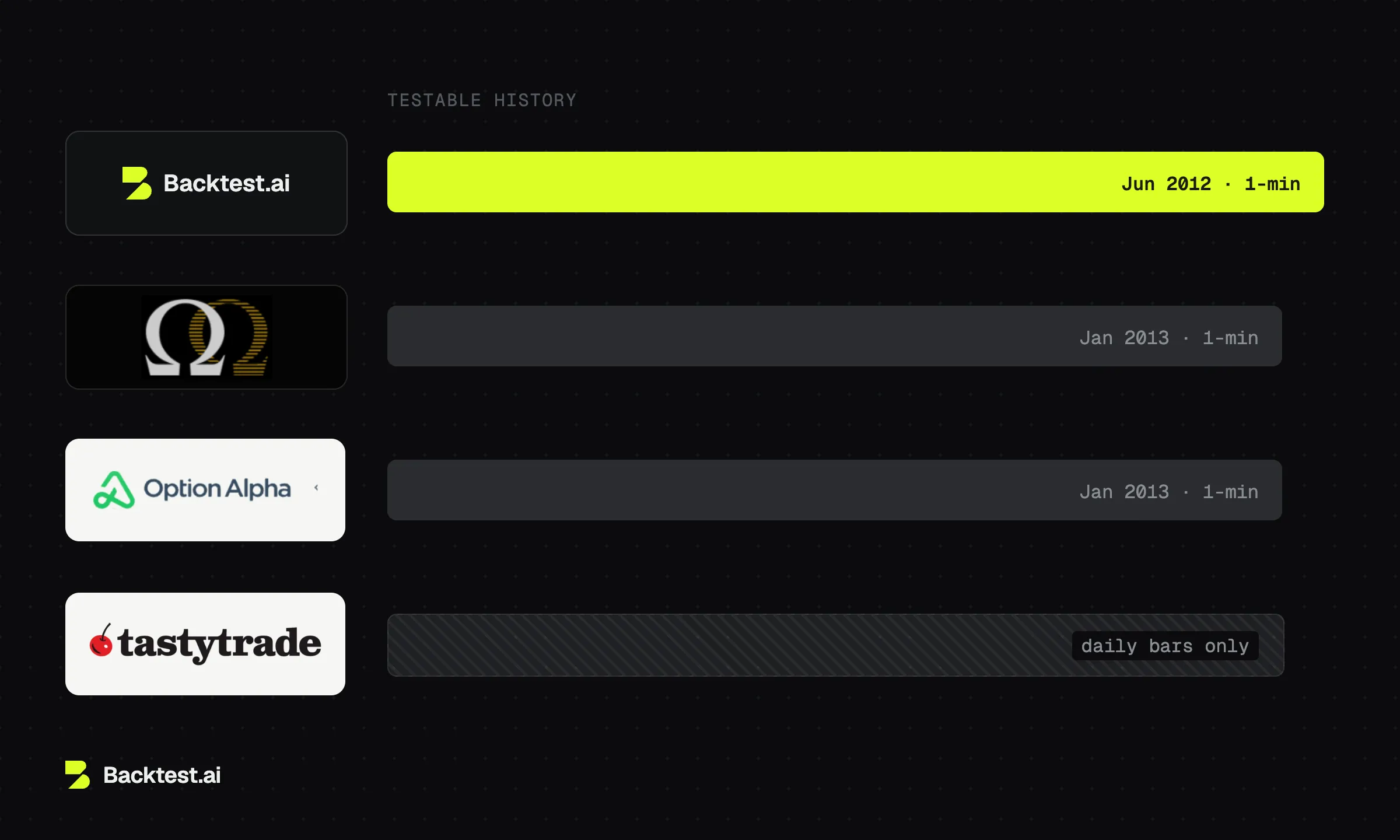
Most of what's written about options backtesting software describes products that no longer exist. Option Alpha rebuilt its backtester on June 24, 2026. Option Omega turned itself into an automation platform. The advice still circulating predates both, some of it by years. The tools moved. The reviews didn't.
Here's where things stand as of July 2026, receipts below:
- Option Omega is the most capable no-code options backtester you can subscribe to today, if you accept mid-price fills, no validation layer, and a UI from another decade.
- Option Alpha is the best free one, if eight defined-risk templates on five index tickers covers everything you trade.
- ORATS has the broadest universe by far, 5,000+ symbols back to 2007, and data quality problems we've hit personally. EOD only.
- tastytrade's built-in backtester is a fine free sanity check and nothing more.
- DIY Python is the right call when the engineering is the part you enjoy.
- Backtest.ai (ours; calibrate accordingly) is in closed alpha, built for the one job none of the above do: telling you whether the edge is real before you trade it.
The rest of this page is the evidence, including two tests we ran ourselves: what happens when you hand Option Omega a trillion dollars [it fills the order], and what an ORATS trade log shows when you actually read it.
How we evaluated, and how to read a "best" list written by a vendor
Disclosure first: we're building one of these tools, and we hold paid subscriptions to every other tool on this page. The tests below came from those subscriptions and are reproducible. Judge accordingly.
Six criteria, in order of how much they decide:
- Data. Resolution times depth, and what the window can actually see.
- Fill model. The assumption that decides whether the equity curve is real.
- Margin. Whether the sizing the backtest used was legal at a broker.
- Expressiveness. Structures, custom signals, and whether anything validates the result.
- Path to live. Automation, and whether what you tested is what trades.
- Price. Against the stack it replaces, not the sticker.
The first three decide whether a backtest means anything. The last three decide whether you can live with the tool. This is a software comparison: every number below demonstrates how tool design changes what a backtest shows, and none of it is a claim about what any strategy returns.
The two dimensions that decide the pick
Both of these are runs from our own engine, written up in full in our options backtesting guide.
Fills. One 0DTE SPX iron condor, the same 876 trades, run twice: once at mid-price fills, once through a fill model calibrated on NBBO quote and trade data. Mid fills finished +222%. Modeled fills finished +4.8%. The strategy's whole per-spread edge was $2.92, and realistic fills took back $2.39 of it. Every tool below that fills at mid plus a flat slippage number is showing you the left-hand version.
The window. One 30 DTE SPX put credit spread, two windows. On 2017 alone: 69 trades, 69 winners, worst drawdown 7.1%. On the full window, the same rules ride $100k up to $8.9 million and down to $718, because 2015, 2016, and 2018 exist in it. Data depth decides whether the bad years get to testify.
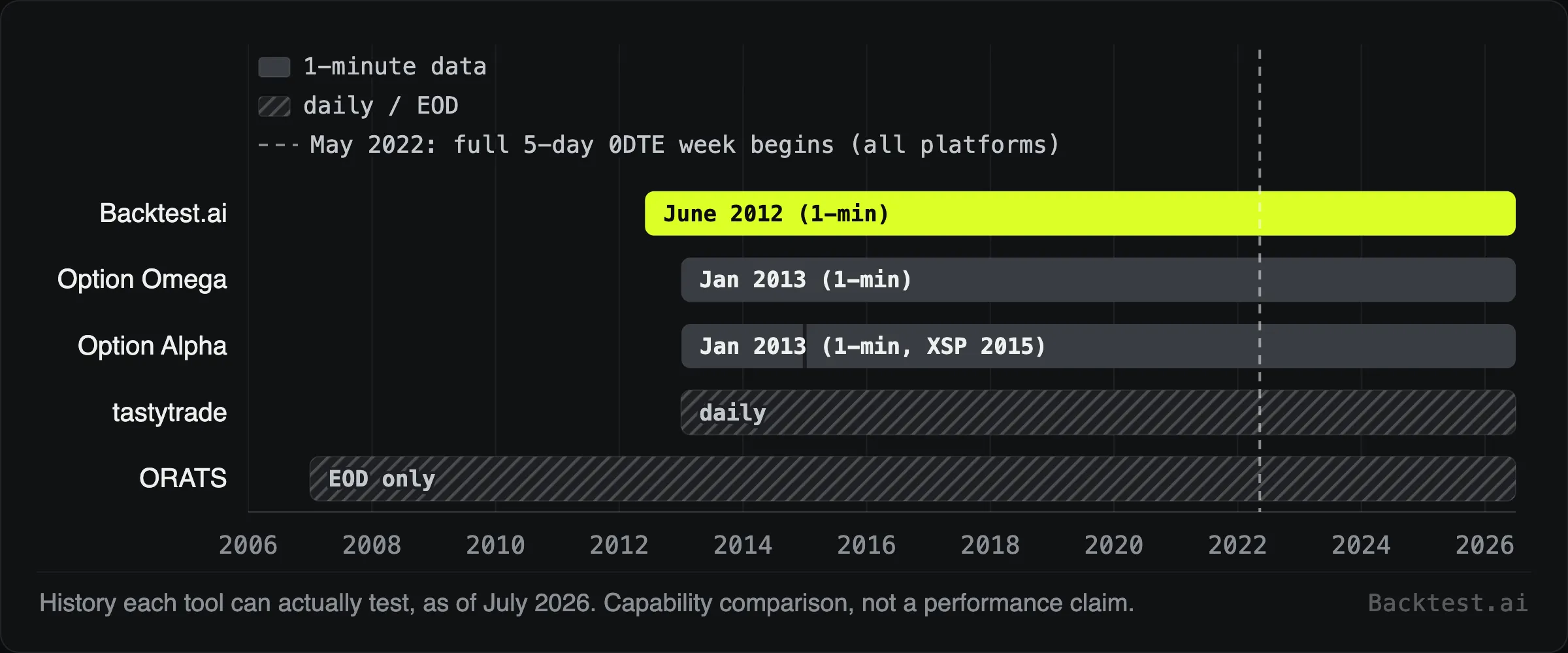
One caveat binds every tool on this page, ours included: 0DTE history only exists from when daily expirations listed. SPX added Tuesday and Thursday weeklys in April and May 2022, so a five-day 0DTE backtest starts there no matter whose data you buy. A "ten-year 0DTE backtest" is mostly a backtest of Fridays.
Options backtesting software, compared
Capability comparison as of July 3, 2026, from vendor pages, docs, and hands-on use. Software features only; nothing here is a claim about trading results.
Option Omega: the strongest backtester money can rent, with three structural catches
If you need a backtester today and you want it no-code, this is the one. The data runs at 1-minute resolution back to January 2013 and the exit logic is the deepest in the category. Four tiers: Model at $29.99 a month, Backtest at $99.99, Backtest + Model at $129.99, and Automate at $299.99, which runs a validated config as a cloud bot through tastytrade, Tradier, or Schwab. Annual billing cuts the backtesting tiers roughly in half. The docs are decent and the community is genuinely useful.
Now the catches, because they're structural.
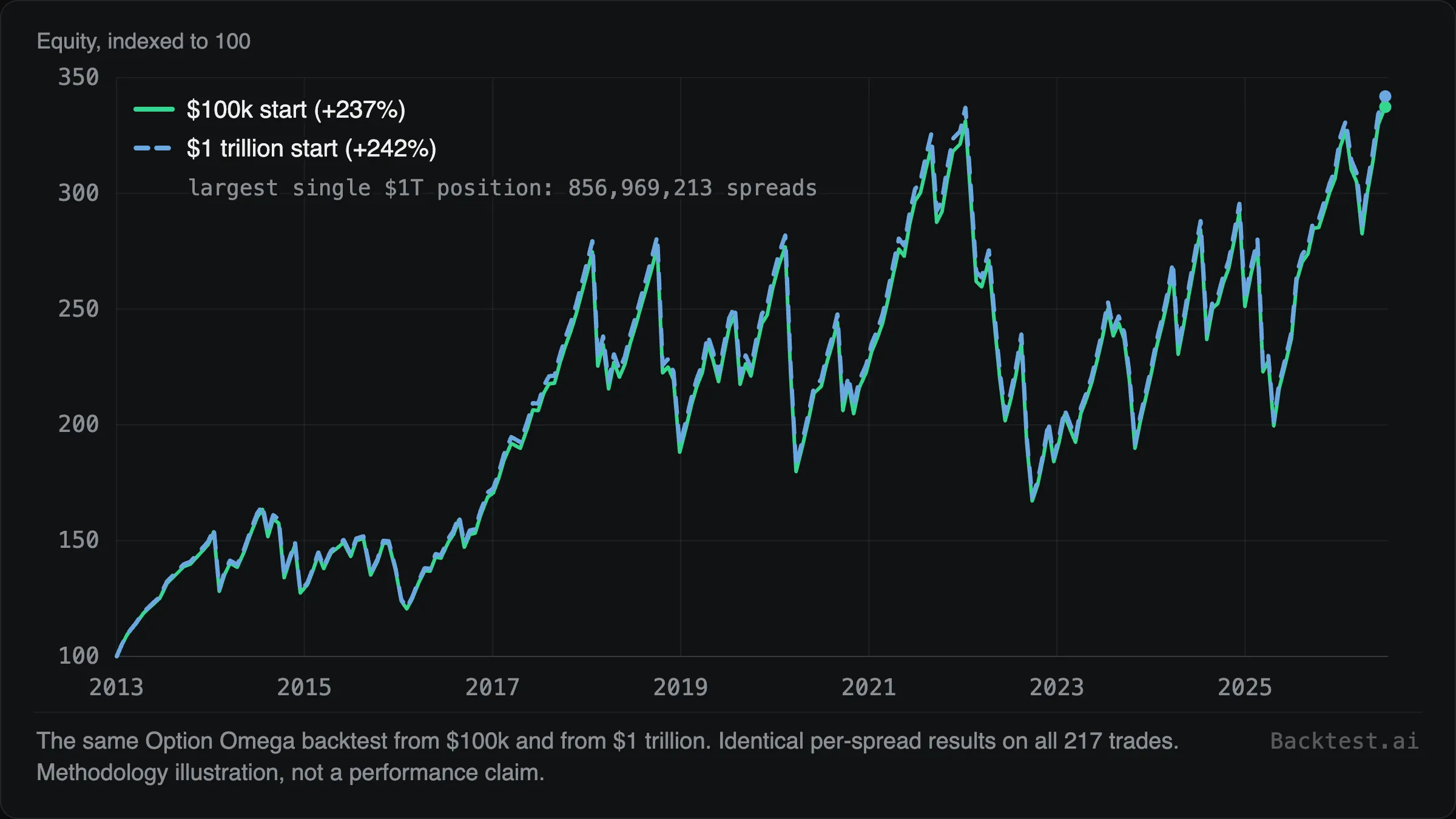
Fills are mid plus a flat dollar figure you type in, and nothing in the engine knows how big your order is. We tested that directly: the same SPX 30-delta, 30 DTE put spread, sized at 20% of the portfolio, backtested from a $100,000 account and from a $1,000,000,000,000 account. One trillion dollars. Per-spread P&L came back identical on all 217 trades: same 73.7% win rate, same $159.12 average win and $331.84 average loss per spread. The trillion-dollar run's largest position was 857 million spreads, roughly 1.7 billion SPX contracts, filled at the same price the $100k account paid for 84. For scale, SPX trades about three million contracts a day in total, across every strike and expiration. The trillion-dollar account even finished slightly ahead, +242% versus +237%, because contract rounding stops costing anything at nine-digit size. A poker simulator that pays the same pot whether you buy in with $100 or the GDP of Earth is not simulating poker.
Second, there is nothing downstream of the backtest. No signal layer beyond uploading a CSV you computed somewhere else, no walk-forward, no out-of-sample anything, and no optimizer either: a parameter sweep means re-running the config by hand and keeping the curve you like best. Nothing in the tool can tell you whether the curve you kept was edge or luck. Sweep long enough and it's luck.
Third, the UI has aged badly, and you'll feel it most in exactly the place you live: comparing dozens of runs. The docs absorb some of the pain.
Best for: premium sellers who want the deepest no-code exit logic available today, and who'll do their validation somewhere else. Full review: Option Omega review.
Option Alpha: the best free option, inside a box
The right answer for a specific trader, and free for that trader. Since the June 24, 2026 upgrade, the backtester covers 1-minute data back to January 2, 2013 (XSP from 2015) and expirations out to 45 DTE, which retired most of the old criticism overnight. Connect a Tradier account holding $5k or a TradeStation account holding $10k and the subscription costs nothing; otherwise it's $99 a month billed annually, $149 month to month. The automation is the most polished here: no-code bots through four brokers, capped at $100k of allocation per bot.
The box: eight defined-risk position types on five index tickers. No naked short options, so no wheel, no strangles, no short puts. Fills are mid plus a flat dollar offset, margin is a max-loss reserve because nothing undefined-risk exists to make margin hard, and there is no signal or validation layer at all. If the templates cover everything you trade and you qualify for free, stop reading and go open an account. Everyone else will hit a wall, and which wall depends on your book; our Option Alpha review walks the June upgrade, the Top Backtests leaderboard problem, and the missing methodology docs in full.
Best for: defined-risk index traders who value hands-off automation over research depth, at the best price in software.
ORATS: the biggest universe, and the data we stopped trusting
On paper, the outlier: 5,000+ symbols, history to 2007, 25 strategy types, scan and backtest across the whole universe. Nobody else on this page touches single names at that breadth, and if your research question is "show me this structure across two thousand tickers," ORATS is the only tool here that even claims the job.
Our own use is why it sits this far down the page. Everything is end-of-day, with entries marked from quotes about 14 minutes before the close. That part is documented and fair: nothing intraday, nothing 0DTE, no stop that fires inside a day. The undocumented part is what we found when we ran a deliberately dumb strategy as a data-integrity check: a long 75-delta call on UVXY, rolled at 45 DTE, no entry signal at all. UVXY is a decaying levered vol product; buying calls on it forever should produce a smooth, boring bleed, which is exactly why we picked it. ORATS printed a 41.38% overall annual return. The trade log explains how. An always-in strategy has zero trades for 626 days between March 2014 and November 2015, zero for another 596 days between January 2024 and August 2025, a dozen more multi-month holes besides, and essentially all of the profit arrives in two vertical single-day spikes of the kind bad marks produce and real fills don't. A dashcam that switches off during the crashes is worse than no dashcam, because you'll drive like you're covered.

The UI, while we're here, is at least as rough as Option Omega's, with thinner documentation to catch you.
Best for: broad single-name scanning, treating every output as a lead to verify rather than a result to size.
tastytrade: the free sanity check
Free with an account, and honest about what it is. Pick a symbol, a strategy template, strike deltas, DTE, and exits by profit target, stop, or days held, and it replays history back to 2013 on daily data, so nothing it tests can live inside a day, and 0DTE isn't offered at all. For a first pass on "does this structure even make sense on this underlying," it's fine, and the price is right.
It has no custom signals and no validation, and while fills appear to mark at mid against what looks like Reg-T margin, none of that is written down anywhere we could find, which for software touching money decisions is itself an answer. A fast reading, like a bathroom scale. Don't ask it for a diagnosis.
Rolling your own in Python: the honest cost accounting
backtrader, backtesting.py, and friends cost nothing and can express anything. What they can't do out of the box is options: no chain data, no accurate fills, no expiration or assignment mechanics, no margin engine. The libraries are equity-native, so the options part is the part you build.
Priced honestly, that's a data subscription ($99 to $999+ a month for usable chains, data storage, and infrastructure) plus the engineering: chain alignment, corporate actions, a margin model, and a fill model you'll have to defend to yourself. If that sounds like a fun winter, it genuinely can be, and we do mean a whole winter: months of nights and weekends before the first run you'd trust. The upside is you'll trust the tool completely, because you watched it being born. Our guide to backtesting options in Python covers the libraries and where each one stops.
Best for: engineer-traders who count the build as a hobby rather than a cost.
Backtest.ai: the validation layer this category is missing
Ours. Read the next three paragraphs with that in mind.
Every tool above answers one question: what did this configuration return over this window. None of them can answer the prior question, whether the thing driving your entries predicts anything at all. That's the layer we built first: signals you define visually or in a DSL, EDA that plots signal against outcome before any backtest runs, and walk-forward validation that judges a strategy on data it never saw.
Under that sits the simulation this page keeps measuring everyone against: 1-minute data back to 2012, fills you can set to mid-plus-slippage if you want the flattering version or run through the fill model if you want the one that cost the condor above 217 points of return, and Reg-T or portfolio margin. When a strategy passes, it promotes to paper or live as an immutable snapshot, so the account provably trades the exact thing you validated, using the same execution engine as the backtest.
The honest part: we're in closed alpha. You can't subscribe today. You can join the launch list, and selected applicants get the beta free. Judged on the six criteria at the top of this page, this is the tool we wished existed while we were paying for everything else on it. That's why it exists.
Free options backtesting software
The real answer is Option Alpha through a broker: $5k at Tradier or $10k at TradeStation zeroes the subscription, and you get the whole platform, box included. tastytrade's backtester is free with any account. Both are genuinely free, not trial-free.
Past those two, free means EOD data and a spreadsheet, which can honestly test a slow defined-risk strategy that never acts intraday, or backtesting.py plus a data bill, which stops being free the moment you buy chains. What no free tier anywhere includes: realistic fills, deep history, or any way to tell whether you curve-fit. The two experiments at the top of this page are exactly the errors free tooling can't catch.
How to sanity-check any backtest before you trust it
Whichever tool you pick, run the output through five questions, in this order.
- Expectancy against the loss tail, before win rate. The 90%-win-rate spread in our window test averaged $164 per winning spread and $724 per losing one. The win rate was the sales pitch; the tail was the price.
- Trade count, across regimes. 69 trades in one calm year is an anecdote.
- The fill assumption. If it's mid plus a constant, ask what's left after the spread takes its cut on every leg, twice per trade.
- Margin. If the tool can't compute it, or lets you switch it off, the sizing is fiction.
- Out-of-sample. If every year of data fed the optimizer, you've learned the past by heart. Walk-forward analysis is the discipline.
How our engine handles each is written up in our methodology, which is the page we'd want every vendor on this list to publish.
Options backtesting software FAQ
What is the best options backtesting software?
For most systematic options traders paying today: Option Omega. 1-minute data to 2013, the deepest exit logic in the category, from $99.99 a month, with the caveats above (mid fills, no capacity model, no validation). Option Alpha wins instead if its eight defined-risk templates cover your trading and you qualify for the broker-subsidized free tier.
What is the best free options backtesting software?
Option Alpha with a qualifying broker connection ($5k Tradier or $10k TradeStation). tastytrade's built-in backtester is also free with an account, with a shallower feature set and daily resolution.
Can you backtest options on thinkorswim or TradingView?
Not programmatically. thinkorswim's OnDemand is manual replay, one session at a time. TradingView's Strategy Tester has no options chains, so approximations run on the underlying's price series and discard the spread, the greeks, and the expiration.
How far back can you backtest 0DTE strategies?
Only to when daily expirations listed. SPX got Tuesday and Thursday weeklys in April and May 2022, so full five-day 0DTE history starts there on every platform. Friday-only 0DTE data reaches back further; whole-week backtests don't.
Is Option Omega better than Option Alpha?
Different customers. Omega is the more serious research tool: more tickers, undefined-risk structures, deeper exits. Alpha is free via broker, has more polished automation, and a smaller box. Both fill at mid plus a flat offset, and neither can validate what it finds. Details in our Option Alpha review.
Backtest.ai is analysis and automation software. Nothing on this page is investment advice or a promise of trading results, and backtested performance never guarantees live performance, on any platform, including ours.

Research notes from Liam, building Backtest.ai: the methodology, the data, and the experiments behind the platform.
Keep reading

Option Alpha Review: An Honest, Tested Look
Option Alpha after the June 2026 upgrade: the best free options automation platform, a usable backtester for defined-risk index strategies — and every layer of it built for simplicity over rigor.

Option Omega Review (and the Alternatives Worth Weighing)
Option Omega is the most capable no-code options backtester you can subscribe to today. The catch: nothing in it can tell you whether the result was edge or luck. An honest review, plus the alternatives.