Option Omega Review (and the Alternatives Worth Weighing)
Option Omega is the most capable no-code options backtester you can subscribe to today. The catch: nothing in it can tell you whether the result was edge or luck. An honest review, plus the alternatives.

Most of what ranks for an Option Omega review is a discount code with paragraphs attached. This page is different: we hold a paid subscription, we build a competing tool [the alternatives section is honest about that], and this is the review we'd want before buying the product.
The short version: Option Omega is the most capable no-code options backtester you can subscribe to today. 1-minute data back to January 2013, the deepest exit logic in the category, and since spring 2025 it will run a tested config live at three brokers. Every serious criticism on this page sits downstream of one fact: the platform runs backtests, and nothing in it can tell you whether the result was edge or luck.
If that gap doesn't bother you, Option Omega is probably your tool. If it does, the details matter.
What Option Omega is
A backtesting platform that restructured itself into an automation platform. The homepage pitch: test on high-resolution data back to 2013, then automate live through Tastytrade, Tradier, or Schwab, no VPS, no code. The tagline is "strong enough for a hedge fund, made for retail traders."
Four tiers: Model does live payoff modeling with Greeks and no backtesting, Backtest is the core product, Backtest + Model bundles the two, and Automate adds cloud-hosted live execution. Prices below.
For serious systematic options retail, this is the incumbent default. It earned that.
The backtester, examined
Credit first, because it's due.
The data runs at 1-minute resolution back to January 2013 on six tickers: SPX, SPY, QQQ, IWM, plus TSLA and AAPL. The single-stock coverage matters; Option Alpha's box is five index products. Where every vendor's history actually ends is its own subject: our historical options data guide.
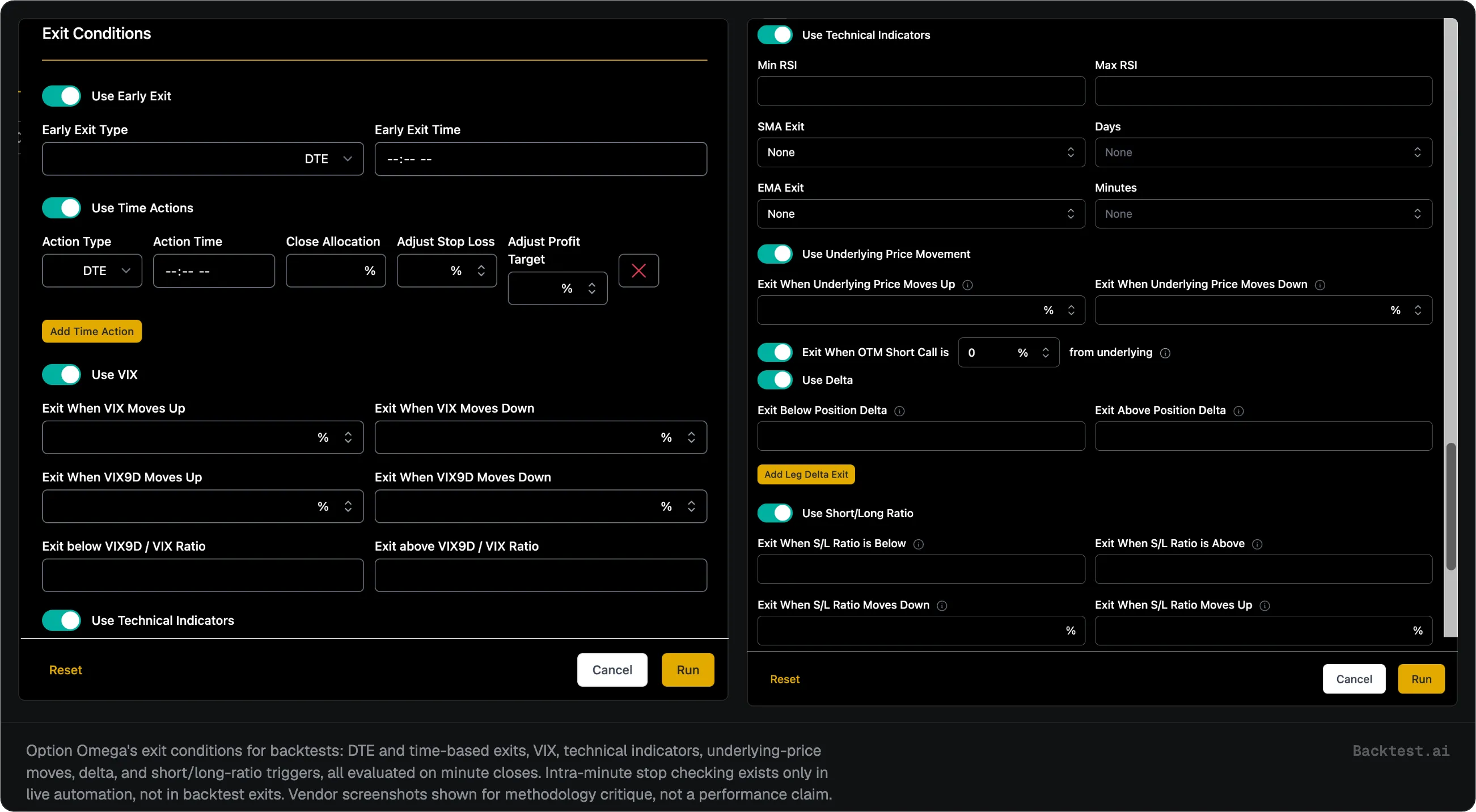
The exit logic is the deepest in the category: profit targets, stops, delta-based exits, exits when the underlying tests a strike, short-leg ratio handling. One scope line their marketing won't draw for you: in the backtester, stops are checked once per 1-minute bar, the same bar-at-a-time cadence most tools quietly run. The intra-minute stop monitoring Option Omega advertises belongs to Automate. Live bots watch stops in real time between bars; the backtest never does.
Sit with what that split means. A once-per-minute check is blind to everything inside the bar: a spike that crosses your stop and comes back never fires in the backtest. The live bot, watching in real time, stops you out. Same minute, same config, two different trades. And the divergence only points one way, live fires stops the backtest never saw, at prices the backtest never marked. Triggering isn't filling either: when a backtest stop does fire, the exit price is the same mid-plus-flat-slippage assumption as every other fill, applied at the exact moment it's most wrong. More on that below.
There's also a CSV-entry mode: upload a file of precomputed values and gate entries on it. Remember that one. It comes back later.
Now the catches.
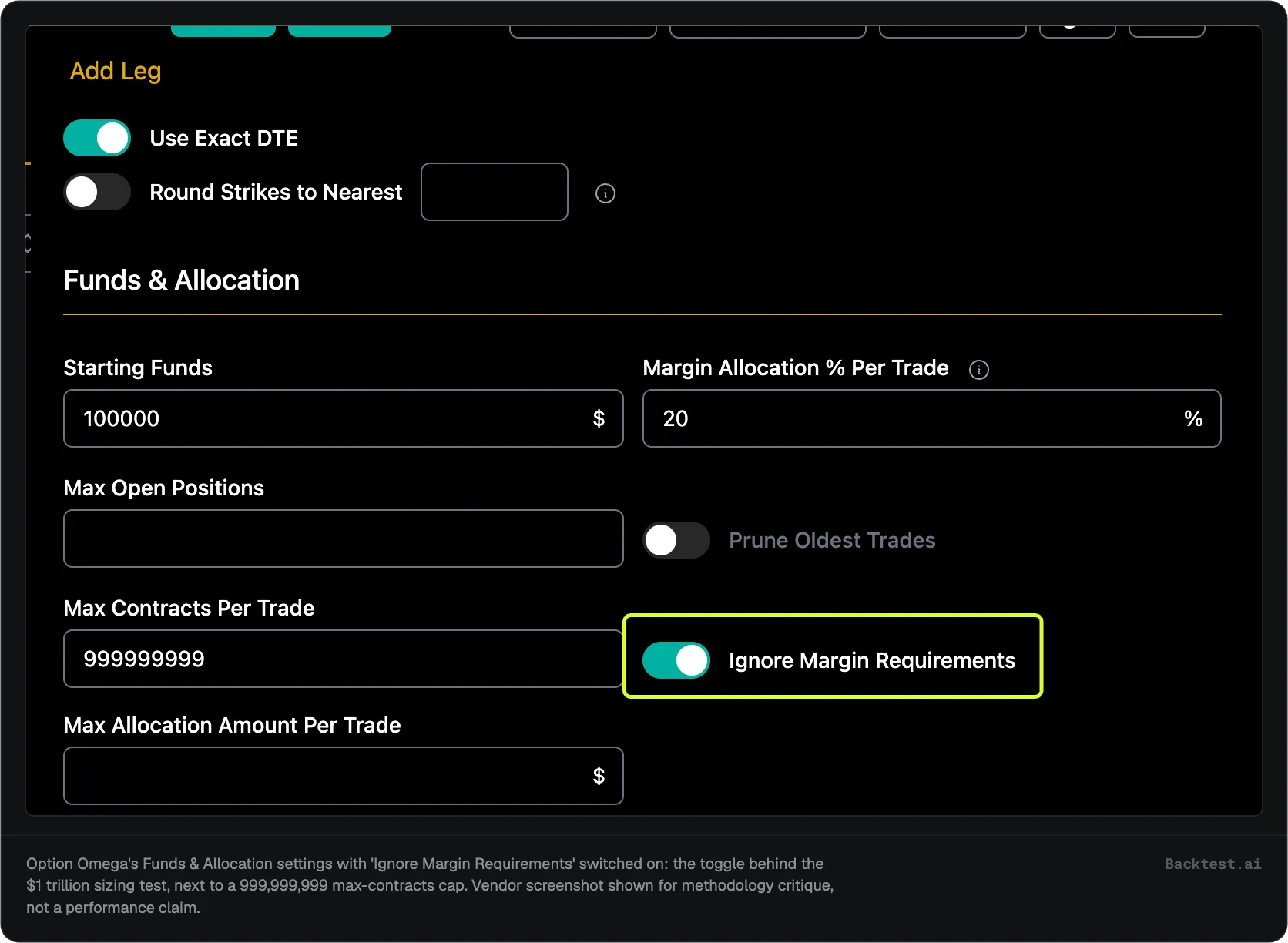
Fills. Every fill is the 1-minute mid price plus a flat per-position dollar slippage number you type in. That's the entire model. A flat offset ignores that real slippage scales with the spread, and spreads are widest exactly when stops fire. The engine is also capacity-blind: nothing in it scales fills to order size. We demonstrated that directly on our best options backtesting software page, running the same SPX put-spread config from a $100,000 start and from a $1 trillion start. Option Omega filled an 856,969,213-spread position and returned identical per-spread results on all 217 trades. The full writeup lives there; the point is that the fill model prices every order like a one-lot.
Margin. The backtester includes an "ignore margin requirements" toggle. Scope that precisely: the live side doesn't inherit it. Automate enforces Reg-T plus your broker's buying-power checks. But Reg-T is also the ceiling. Their docs state the automation calculations "use the same architecture as the backtester ... based on Reg-T, not portfolio margin." If you size a book against PM, that number gets computed somewhere else. We publish our fill and margin modeling down to the marking rules. Self-interested to mention, and checkable: [how we model fills and margin.]
The UI. It has aged badly, and you feel it most in the exact place a research workflow lives: comparing dozens of runs against each other. The docs absorb some of the pain. Some.
Nothing downstream of the backtest
Here's the structural gap, and it's the whole review in one section.
No custom signal layer beyond that CSV upload. No walk-forward. No out-of-sample split of any kind. No models. No optimizer either: a parameter sweep means re-running the config by hand and keeping the curve you like best. Run enough sweeps and the best curve is a raffle winner.
The CSV mode is the tell, twice over. You can gate entries on a value computed somewhere else, which means the platform knows signals matter and outsources them to your spreadsheet. Nothing in the tool can plot that signal against trade outcomes, test whether it predicts anything, or check the relationship on data it never saw.
And the outsourcing is one-way. CSV entry exists in the backtester only; Automate doesn't take the file, and a file of precomputed history has no row for tomorrow anyway. So the one construct that lets you research a signal-gated strategy produces exactly the strategy the automation tier can't run. To trade it live you're coding your own execution, which is the workflow a no-code platform exists to replace. The backtester answers "what did this configuration return over this window" with real precision, and no other question. Our options backtesting guide covers why the other question decides whether the first one means anything.
Automate, examined
The spring 2025 addition, and the reason the platform reads differently now. Automate runs a backtest config as a cloud-hosted bot through Tastytrade, Tradier, or Schwab. No VPS, no code, no babysitting a script at 9:31.
What carries over is genuinely most of it. Creating a strategy from a backtest auto-fills its conditions, and their docs are direct: the choices available in backtesting are available in automation, "with the obvious exceptions of backtest-specific choices such as slippage or Punisher settings." Those two are simulation artifacts, so excluding them is correct rather than a gap. Delta exits, underlying-tested exits, short-leg ratios, and profit actions all transfer.
Four behavioral notes worth knowing before you wire money to it. After creation, the backtest and the live strategy are independent; editing one doesn't update the other, so version drift is on you. SqueezeMetrics data is unavailable in automation. In a spread, longer-dated legs are not auto-closed when the short legs expire, which differs from backtest behavior. And stops run on different clocks: Automate monitors them intra-minute, the backtester checks them once per 1-minute bar, so a live stop can fire at a moment and a price no backtest of the same config ever evaluated.
Those notes share a shape, and the shape is the deeper concern. The backtester and the live bot are two systems that approximate each other, and Option Omega's own docs keep flagging the seams: behavior that differs in automation, data available on one side only, expiration handling that diverges. Each difference is small and, credit where due, disclosed. But a live strategy is only as trustworthy as its resemblance to the thing you tested, and every documented divergence is a place where live results can drift from the backtest for reasons that have nothing to do with the market. When that drift shows up in your account, you won't be able to say which kind it was.
Capital handling is per strategy: a percentage of account NLV, a fixed dollar value, or a fixed contract quantity. Guardrails exist at the account level (Option Omega's funds and allocation checks, the broker's buying-power requirement, and a portfolio-wide cap of 100 opening trades per day). What the docs don't describe is any coordination of capital across strategies: no unified allocator, no winding one strategy down to promote another as a unit. You're running N independent bots that share an account, and the portfolio math between them is yours. The wider comparison is its own page: automated options trading.
What Option Omega costs
Backtest is $99.99/mo, or $49.99/mo billed annually. Backtest + Model is $129.99 and $74.99. Automate is $299.99 and $249.99. The Model tier alone runs $29.99, and it's live payoff modeling rather than backtesting; if you're reading this page, it isn't the product you're evaluating.
The honest read: Backtest at $49.99 annual is the strongest value in paid options backtesting right now, because nothing else at that price carries 1-minute data to 2013 and this exit engine. Automate at $299.99 is a different product priced like one, and whether it earns that depends entirely on how much of your process fits in a config.
Who it's for, and who it isn't
Use Option Omega if you sell premium systematically, want the deepest exit logic in a no-code tool, and either validate your ideas somewhere else or accept that you can't. The community tips the scale more than a feature would: the Discord is one of the most useful in retail options, and the daily show is still running.
Look elsewhere if your entries depend on a computed signal (you can CSV it into a backtest, but Automate can't run it); you size against portfolio margin; you need fills that know how big your order is; or you need to know whether the curve you kept was edge or luck. The platform is on the wrong side of each of those by design, and to its credit, it doesn't pretend otherwise.
The alternatives worth weighing
Backtest.ai is ours, so calibrate accordingly. It exists because of the gap this review keeps circling. The research layer: signals you write in a DSL or build in a UI, point-in-time datasets (earnings, FOMC), and automatic EDA, the scatter and decile plots that answer whether a signal predicts trade outcomes before any backtest runs. The validation layer: walk-forward and out-of-sample built in, so a strategy is judged on data it never saw. The simulation: NBBO fill marking, four fill models from mid-plus-slippage up to a model calibrated on NBBO quote and trade data, and Reg-T plus portfolio margin. And the direct answer to the seams in Automate: research, paper, and live run the same engine, so a validated strategy promotes as an immutable snapshot with a ledger of every state change, and the account provably trades the exact thing you tested. No translation step, so no translation loss.
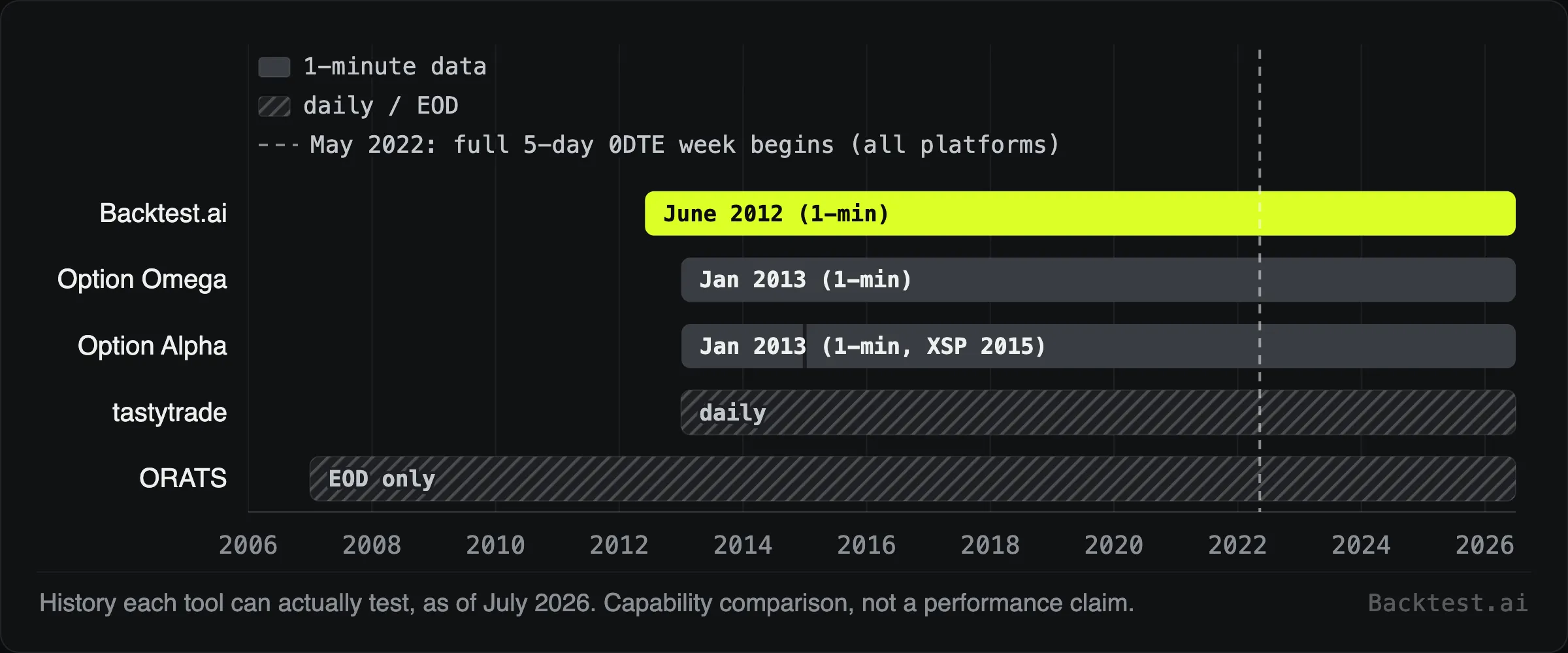
Data runs 1-minute back to June 2012, half a year deeper than Option Omega's 2013. One caveat binds everyone here, us included: the full five-day 0DTE week only exists from around May 2022, when the daily SPX expirations finished listing, so no tool can show you a 0DTE backtest in 2012. The extra depth matters for multi-day and longer-DTE strategies. We're in closed alpha, with a closed beta opening soon; selected applicants get it free.
Option Alpha is the budget answer if its box fits you: eight defined-risk templates on five index tickers, free with a qualifying broker connection ($5k at Tradier, $10k at TradeStation), and the most polished automation of the tools here. Same missing layer, though: no custom signals, no validation, and fills are the same mid-plus-flat-dollar model. Full breakdown in our Option Alpha review.
Capability comparison as of July 2026, from vendor pages, docs, and hands-on use. Software features only; nothing here is a claim about trading results.
Option Omega review FAQ
Is Option Omega worth it?
For systematic premium sellers who want the deepest no-code exit logic and 1-minute data to 2013: yes, at $99.99/mo ($49.99 billed annually) it's the strongest backtester you can rent, with the fill-model and validation caveats above. If your process needs computed signals or out-of-sample validation, that layer doesn't exist there at any tier.
How much does Option Omega cost?
Backtest is $99.99/mo ($49.99 billed annually), Backtest + Model $129.99 ($74.99), Automate $299.99 ($249.99). A $29.99 Model tier exists for live payoff modeling without backtesting.
Option Omega vs Option Alpha: which is better?
Different customers. Omega is the more serious research tool: six tickers including TSLA and AAPL, undefined-risk structures, and deeper exit logic (the intra-minute stop monitoring you'll see advertised is live automation only, not the backtester). Alpha wins on price (free via a qualifying broker) and automation polish. Both fill at mid plus a flat offset, and neither can validate what it finds. Details in our Option Alpha review and our best options backtesting software comparison.
What's the best Option Omega alternative?
Depends on which gap sent you looking. If it's price, and your trading fits eight defined-risk index templates, Option Alpha is free via broker. If it's the missing signal and validation layer, that's the gap Backtest.ai was built around (closed alpha, beta soon). No current tool beats Omega at its core job of no-code backtest depth.
Backtest.ai is analysis and automation software. Nothing on this page is investment advice or a promise of trading results, and backtested performance never guarantees live performance, on any platform, including ours.

Research notes from Liam, building Backtest.ai: the methodology, the data, and the experiments behind the platform.
Keep reading
The Best Options Backtesting Software in 2026
Option Omega, Option Alpha, ORATS, tastytrade, DIY Python, and Backtest.ai, compared on the dimensions that decide whether a backtest means anything: data depth, fill modeling, margin, validation, and price.

Option Alpha Review: An Honest, Tested Look
Option Alpha after the June 2026 upgrade: the best free options automation platform, a usable backtester for defined-risk index strategies — and every layer of it built for simplicity over rigor.