Option Alpha Review: An Honest, Tested Look
Option Alpha after the June 2026 upgrade: the best free options automation platform, a usable backtester for defined-risk index strategies — and every layer of it built for simplicity over rigor.

Every Option Alpha review online right now describes a product that stopped existing on June 24, 2026. That's the day Option Alpha shipped the biggest backtester upgrade in its history: minute-level data back to January 2, 2013, expirations out to 45 DTE, and a stack of position controls the old tool badly needed. If a review tells you the backtester only covers 0DTE and three years of data, it was accurate once. [The reviews aren't lying. They're just old.]
The short version: Option Alpha is the best free options automation platform you can get, a decent on-ramp for beginners, and, since June, a usable backtester for defined-risk index strategies. Every layer of it is built for simplicity over rigor. Whether that trade suits you is the whole decision.
If eight defined-risk templates on five index tickers covers everything you want to test, and you hold $5k at Tradier or $10k at TradeStation, stop reading and go open an account. It costs you nothing. Everyone else, the details matter.
What Option Alpha is
An automation platform first, a research tool second. You build no-code "bots" that enter and manage options positions on a schedule or a trigger, and the backtester exists mostly to feed configurations into those bots. The free tier is broker-subsidized: connect a qualifying Tradier or TradeStation account and the broker pays your subscription, because you just became their customer. Worth understanding, because it means the free tier is real and permanent, no trial games, and the product is built to do exactly one job: get order flow moving as simply as possible.
The education library is large, free, and fine for someone learning what an iron condor is. It's also revealing. Search it for realized volatility, IV versus RV, the variance risk premium, or any notion of validating an idea before automating it: empty. The curriculum teaches structures and mechanics, and the gap matches the customer the product is designed for, someone who wants the tool simple and is willing to trust it.
What Option Alpha costs
One paid plan. Pro runs $99 a month billed annually, $149 month to month. Free comes through the brokers: a connected Tradier account with $5k or a TradeStation account with $10k zeroes out the subscription. There's a 30-day trial with no card. Every path gets the same platform: 50 bots, a $100k allocation cap per bot, unlimited backtesting.
The backtester after the June 2026 upgrade
Credit first, because it's due. The June release moved Option Alpha's backtester from "toy" to "usable":
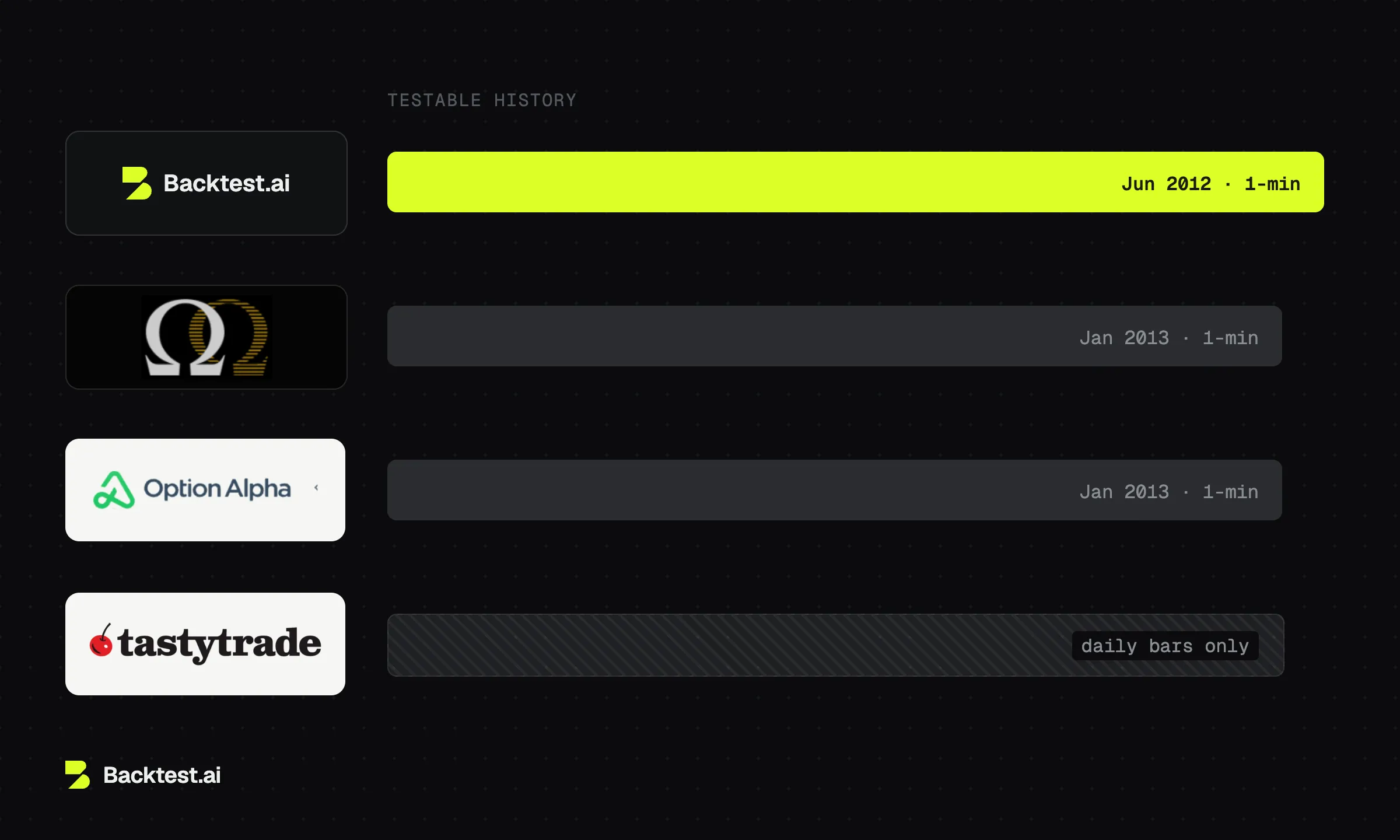
- Data back to January 2, 2013 on 1-minute resolution (XSP starts January 2, 2015). The old rolling three-year window is gone, and the testable history now includes 2018's Volmageddon, 2020, and 2022.
- DTE out to 45, with ranges ("between 7 and 10 days"), and market-versus-calendar day selection. The old tool stopped at 1 DTE.
- Position controls that matter: max concurrent positions, spacing between entries, one-position-per-expiration, sizing by dollar risk or percent of capital with contract caps.
- Exits: dollar-based stop loss and profit taking, plus an "Avoid Events" rule that closes positions ahead of FOMC and CPI dates.
- Workflow: update a live bot in place from a modified backtest without resetting its stats, and export any backtest's positions as CSV.
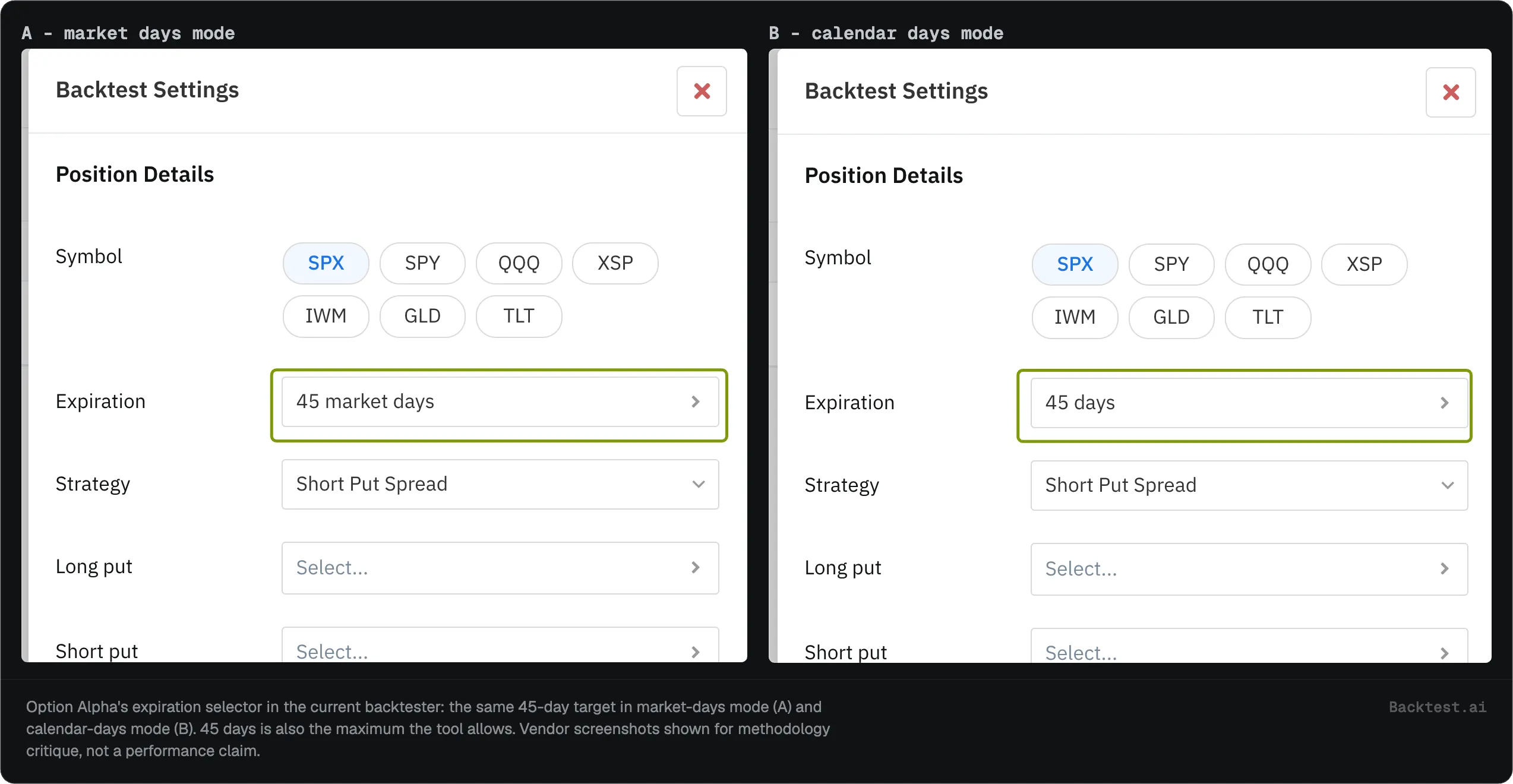
The wall that didn't move is structure. You get eight defined-risk position types: long call, long put, four vertical spreads, iron condor, iron butterfly, on exactly five tickers (SPX, SPY, QQQ, IWM, XSP). No naked short puts, which means no wheel. No strangles, no covered calls, no calendars. The upgrade widened the box considerably. It's still a box.
Where the research stops
Three layers are missing, and they're the ones that decide whether a backtest means anything (our options backtesting guide covers why). Here's how each shows up.
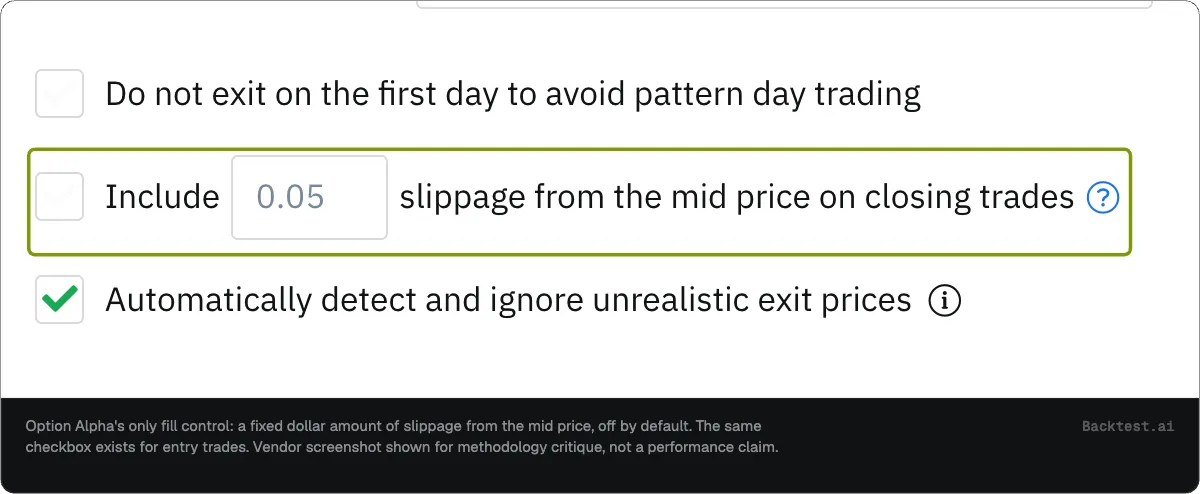
Fills. Every fill is the mid price plus a fixed dollar slippage number you type in. That's the entire model; there is no bid/ask-aware option. The June release added a spread guard that discards exits when quotes go pathological, which is quote hygiene, not fill modeling. A flat offset ignores that real slippage scales with the spread, and spreads are widest exactly when your stops fire. A fixed nickel charges the same toll at 10am on a quiet Tuesday and in the last twenty minutes of a CPI selloff. Live trading doesn't.
Margin. Fair is fair: for the structures Option Alpha supports, capital set-aside is roughly right by construction, since a defined-risk spread's requirement is its max loss and the platform reserves it. The margin question never gets hard because nothing undefined-risk exists to make it hard; there's no naked-option Reg-T engine and no portfolio margin anywhere. The day your book includes a short put, this stops being your tool.
Validation. No custom signals, no models, no walk-forward, no out-of-sample split of any kind. The backtester answers one question: what did this configuration return over this window. It cannot tell you whether your entry condition predicts anything, or whether you just curve fit a beautiful equity curve.
The Top Backtests problem
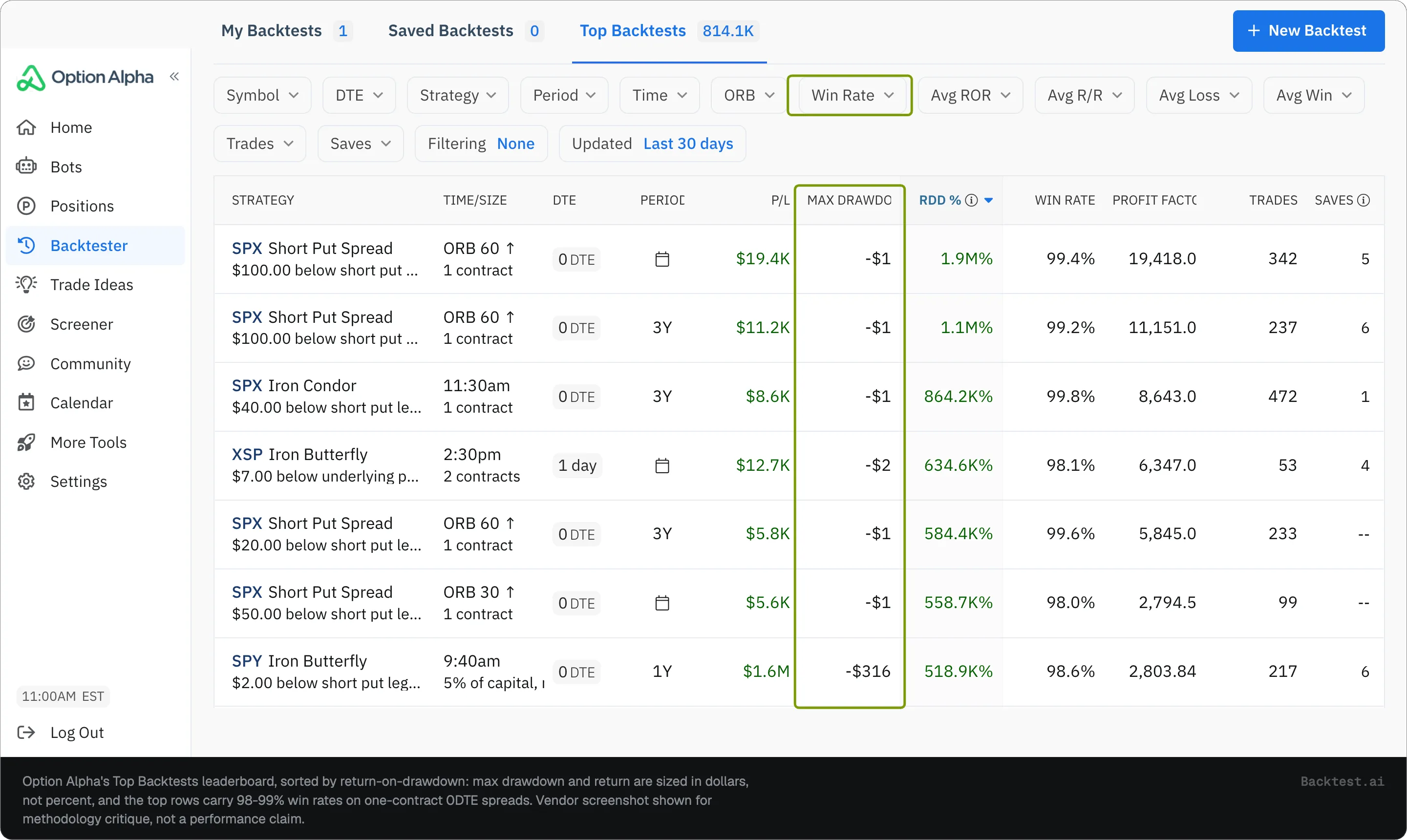
Top Backtests is a community leaderboard of 750,000+ shared backtests, filterable by win rate, return on drawdown, and profit factor. Option Alpha presents it as a gold mine of ready-to-automate plans.
Statistically, it's a lottery drum. Sort three-quarters of a million configurations by any performance stat and the top of the list is dominated by luck, by construction. A strategy with no real edge at all posts a 70%+ win rate over 30 trades about once every 50 tries. Across 750,000 entries, that's thousands of impressive-looking accidents before you count the ones that were curve-fit on purpose. Somebody wins the lottery every week. The winning numbers still aren't a system.
Option Alpha half-knows this. The June release added a button to flag backtests as "invalid for live trading," which is the feature you build when your leaderboard keeps filling with curves nobody should trade. What it didn't add is a way to tell the difference. That's what validation is for, and it's the layer the platform doesn't have.
The documentation problem
Now try to find any of the above in writing. You won't. The fill assumption above came from using the product, because Option Alpha publishes no methodology: nothing on how fills are marked, how stop exits get evaluated inside a bar, where the data comes from, or what the paper-trading engine assumes. For a subscription newsletter that would be a nitpick. For software that places live orders with your money, it's a cost. A car with the hood welded shut can be a perfectly good car. You're still allowed to ask why the hood is welded shut.
We publish how we model fills and margin down to the marking rules, which is a self-interested thing to bring up, and also checkable.
The bots
This is what the platform is actually for, and it's good. Four brokers are live for automation: tastytrade, TradeStation, Tradier, and Schwab, with Webull and Public listed as coming soon. The decision-tree logic is genuinely no-code, order handling has configurable pricing behavior, and since June you can revise a running bot from a new backtest without losing its history.
The ceiling is the $100k hard allocation cap per bot, times a maximum of 50 bots. At $50k of capital the cap is invisible. At $500k you're running a bot committee, splitting one strategy across parallel bots and reconciling them yourself.
Who it's for, and who it isn't
Use Option Alpha if you're newer to options and want a guided path from template to automated trade; you sell defined-risk spreads on the big index products inside 45 DTE; you qualify for the free tier; you value hands-off execution over research depth.
Look elsewhere if you trade strangles, the wheel, or anything undefined-risk; you size against margin; your entries depend on a signal you'd have to compute yourself; you want to know why a backtest worked, not just that it did; or unverifiable modeling is a dealbreaker for money-touching software. It's on the wrong side of every one of those, honestly rather than incompetently. It chose its customer.
The alternatives
Option Omega is the closest comparison and the more serious research tool of the two: the same January 2013 data start on 1-minute bars, a six-ticker list (SPX, SPY, QQQ, IWM, TSLA, AAPL), undefined-risk structures, deeper exit logic, and its own automation tier at $299.99 a month. It shares Option Alpha's missing layer, though: no custom signals, no validation. Full breakdown in our Option Omega review.
Backtest.ai (that's us, calibrate accordingly) is built for the trader who outgrew the template box: signals you define, EDA that shows whether they predict anything before you backtest, walk-forward validation, fills marked against the NBBO with a calibrated fill model, Reg-T and portfolio margin simulated, and 1-minute data back to 2012. One caveat that binds everyone in this table, us included: 0DTE history only exists from when daily expirations listed, so no tool can show you 0DTE in 2012. We're in closed alpha, with a closed beta opening soon.
Capability comparison as of July 2026, from vendor pages, release notes, and hands-on use. Software features only; nothing here is a claim about trading results.
Option Alpha review FAQ
Is Option Alpha actually free?
Yes, with a connected Tradier account holding $5k or a TradeStation account holding $10k; the broker subsidizes your subscription. Otherwise Pro is $99/mo billed annually or $149 month to month, with a 30-day free trial.
How far back does the backtester go now?
Since June 24, 2026: January 2, 2013 for SPX, SPY, QQQ, and IWM, and January 2, 2015 for XSP, all on 1-minute data. Reviews citing a three-year window predate the upgrade.
Can you backtest strangles or the wheel on Option Alpha?
No. The backtester supports eight defined-risk position types. No naked short options means no strangles, no cash-secured puts, and no wheel, for testing or automation.
Option Alpha vs Option Omega?
Option Alpha wins on price (free via broker) and automation polish. Option Omega wins on research scope: more tickers, undefined-risk structures, deeper exit logic. Neither has a signal or validation layer. If research depth is the deciding axis, see our best options backtesting software comparison.
Backtest.ai is analysis and automation software. Nothing on this page is investment advice or a promise of trading results, and backtested performance never guarantees live performance, on any platform, including ours.
Research notes from Liam, building Backtest.ai: the methodology, the data, and the experiments behind the platform.
Keep reading
The Best Options Backtesting Software in 2026
Option Omega, Option Alpha, ORATS, tastytrade, DIY Python, and Backtest.ai, compared on the dimensions that decide whether a backtest means anything: data depth, fill modeling, margin, validation, and price.

Option Omega Review (and the Alternatives Worth Weighing)
Option Omega is the most capable no-code options backtester you can subscribe to today. The catch: nothing in it can tell you whether the result was edge or luck. An honest review, plus the alternatives.